People and issues
Who Went to Court, and Who to Beis Din?
The central procedural question: who chose the civil courts, and when.
The question
As posed in the correspondence: the impression from Mrs. Ort’s camp is that only after R’ Avrohom took her to secular court and lost is he now insisting on Beis Din — and since he accepted binding arbitration, why is he complaining? This page answers with documents.
Who filed first
Page 8 of the Final Arbitration Ruling, headed “Procedural History,” states that Mrs. Ort filed the divorce complaint on February 4, 2000, accompanied by an Order to Show Cause freezing assets — including the children’s and the Dove Foundation’s assets — and that a March 6, 2000 order continued the restraint: Page 8 of the Final Arbitration Ruling: procedural history of the divorce — view .
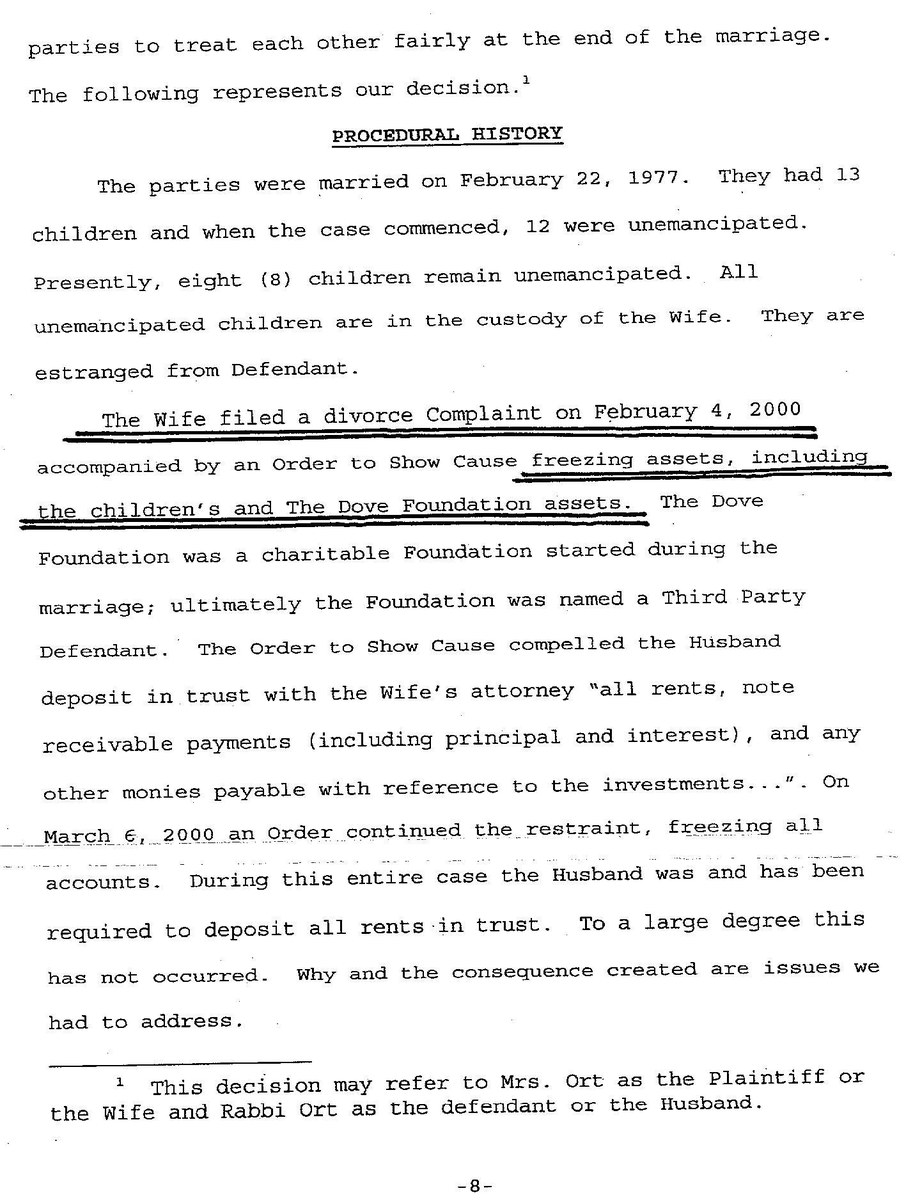
The correspondence adds that every court document names Mrs. Ort as Plaintiff and R’ Avrohom as Defendant.
Who went to Beis Din
R’ Avrohom’s response to the court summons, the correspondence says, was to go to Beis Din — which sent Mrs. Ort a letter in February 2000, at the same time she was applying to the court, urging her as a matter of halacha to come to any Beis Din. The siruv was unsigned at that point, pending her response to the customary three hazmanos.
Why binding arbitration
On the arbitration question, the correspondence’s account is this: R’ Avrohom agreed to binding arbitration under New Jersey law only as the alternative to a court case under New Jersey law — the choice Mrs. Ort forced on him, in the correspondence’s telling, by going to arkaos in the first place. It was, the correspondence says, only a question of a single judge or a panel of three; he chose the panel appointed by the judge, and his attorney’s letter explains why.
The page closes with a wry comment attributed to one of the Rabbanim involved: if halacha views a frum Jew forcing another frum Jew into arkaos as equivalent to hiring someone to get the money for you, then forcing a frum Jew into arkaos to accept an arbitration panel is equivalent to hiring someone to get someone else to get the money for you.
This page summarizes the case for the Beis Din position as presented in the correspondence. The legal and halachic characterizations are the correspondence’s own; the ruling page linked above is presented as cataloged.